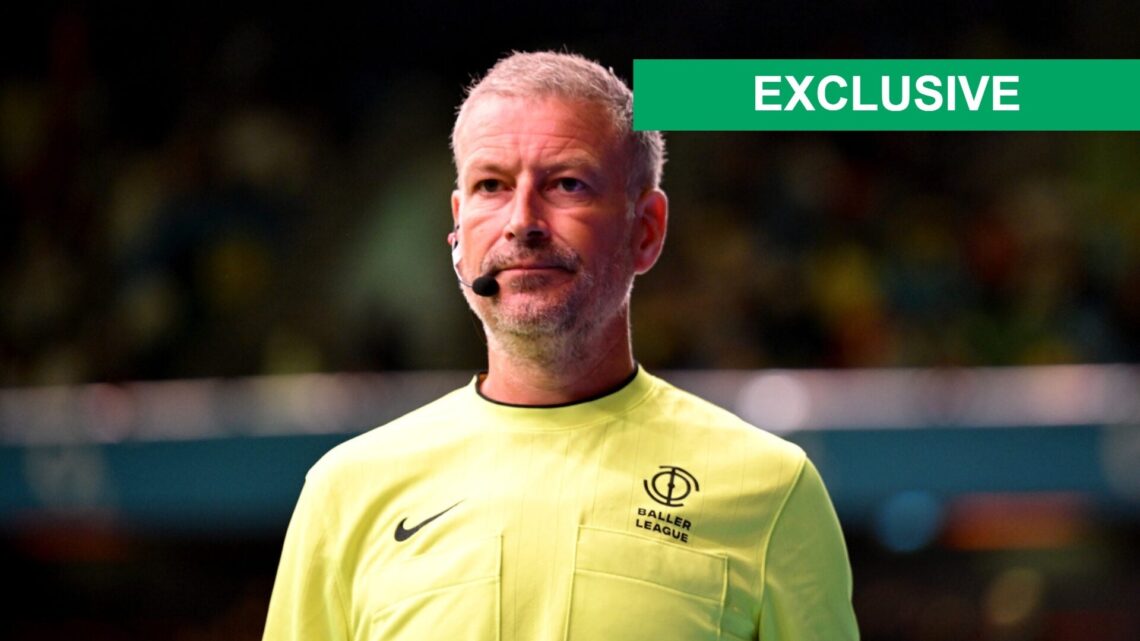


Kris Boyd insisted Alistair Johnston should have seen red against Rangers, but Mark Clattenburg’s explanation completely changes the discussion around the Celtic defender’s challenge on Mikey Moore.
Boyd called it “a red card all day long”, yet the former FIFA referee made it clear why the officials got the decision right by stopping at a yellow card.
Listen to Boyd’s take on the challenge here:
However, despite Boyd’s unwavering certainty that Johnston should have seen red, Clattenburg had a more balanced view on the incident.
Is Maeda’s overhead kick the best you’ve seen scored in a Glasgow Derby? If not, what was? 👀
Comment your answers below 👇

Mark Clattenburg explains why Alistair Johnston challenge was not serious foul play
Clattenburg’s analysis focused on the actual mechanics of the tackle rather than the emotional reaction that followed it.
The former referee exclusively told 67 Hail Hail, “Alistair Johnston of Celtic committed a heavy tackle on Mikey Moore of Rangers which some people will say it’s a red card. I believe the decision to award a yellow card is correct as Johnston is reckless in the challenge.
“When you slow the challenge down the studs and foot come in front of Moore and not direct to the leg which creates a tripping action and not a challenge which could have endangered the safety of his opponent.”
That distinction matters because Clattenburg is clearly separating a reckless challenge from serious foul play.
The tackle looked ugly in real time and even worse on replay, but Clattenburg’s point is that Johnston’s motion came across the player rather than through him.
Kris Boyd’s reaction ignored the actual laws of the game
Boyd’s instant reaction was predictable given the emotion around the Glasgow Derby.
However, the actual laws of the game support Clattenburg’s interpretation rather than the Sky Sports pundit’s outrage.
IFAB defines serious foul play as challenges which use excessive force or are guilty of “endangering the safety of an opponent”.
Clattenburg’s explanation directly addressed that threshold.
His argument was not that Johnston’s tackle was clean. It clearly was not. The point was that the challenge did not meet the standard required for a straight red card.
That is why the yellow card stood despite the immediate uproar around the incident.
Slow-motion replays made the tackle look worse than it was
Clattenburg also highlighted a problem modern football constantly runs into during controversial moments.
Slow-motion footage can distort the intensity of a tackle and make contact appear more dangerous than it actually was in real speed.
That is especially true when studs are visible during a challenge.
Many supporters instantly assume studs showing automatically means a sending off, but referees are instructed to judge force, direction, point of contact and whether the opponent’s safety was genuinely endangered.
Clattenburg’s breakdown tackled all of those areas directly.
It does not mean everyone will suddenly agree with the decision, but it does undermine the claim that Johnston escaping a red card was some kind of officiating scandal.
The tackle was reckless and deserved punishment. Even Clattenburg admitted that much.
But there is a major difference between a bad tackle and a clear red card offence, and the former FIFA referee made it clear why Johnston’s challenge fell into the first category rather than the second.
Receive a digest of our best Celtic content each week direct to your mailbox