Michael Stewart’s ban during Celtic’s Scottish Cup semi-final has now forced referees to draw a clear and public line on criticism in Scottish football.
The decision to remove him from Hampden during Celtic’s clash with St Mirren had already raised questions about how scrutiny of officials is being handled.
That situation has now moved on, with referees stepping in to release a statement to clarify on what they believe crosses the line.
Their intervention shifts the focus beyond one pundit and into how criticism itself is being controlled in Scottish football.
Banning a pundit over comments about referees: the right decision or setting a dangerous precedent?
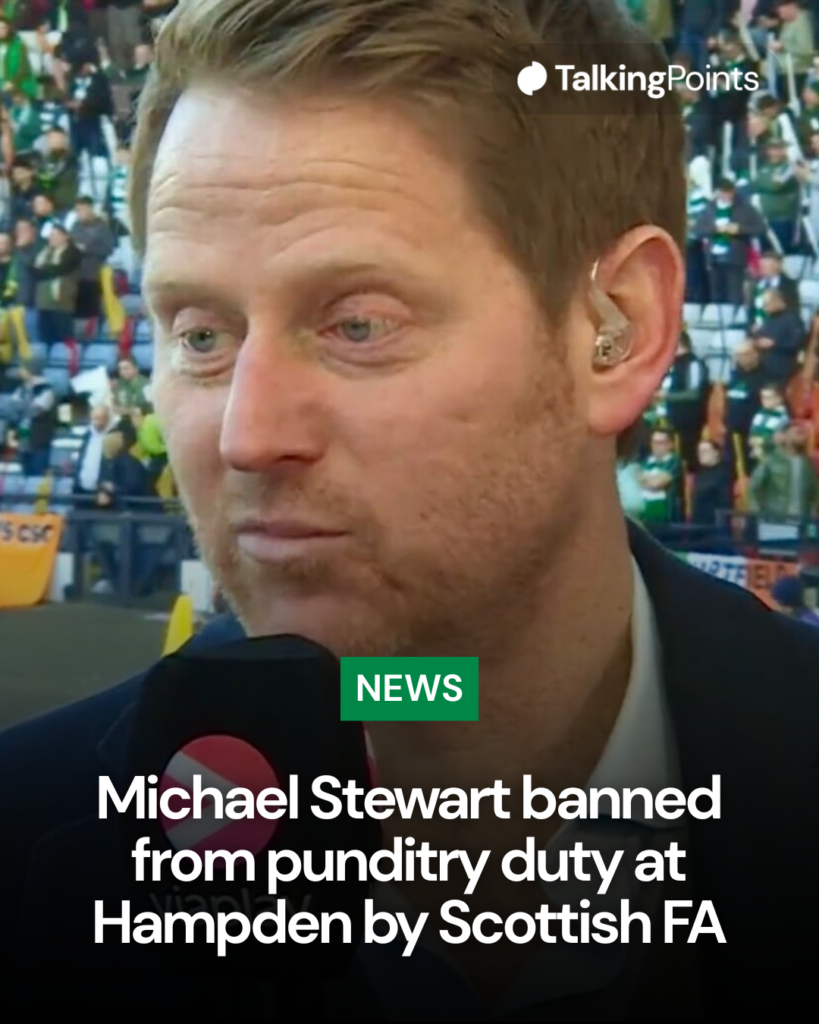
Celtic Hampden clash became the setting for referees to take a firm stance
Stewart was banned from Hampden for Celtic’s Scottish Cup semi-final vs St Mirren, removing him from coverage at the national stadium.
That ban unfolded after the SFA took action on criticism the Premier Sports pundit has aimed at referees recently.
The situation escalated in the build up to the Celtic match, turning the Hampden showpiece occasion into a bit of a circus.
And now, the controversy has escalated further as referees make their feelings public to back the action, making their position clear.
Celtic context shows how firmly referees are now defining limits on criticism
The referees’ statement set out their stance in direct terms and left little room for ambiguity.
“The SSFRA notes the action taken by the Scottish FA in respect of Michael Stewart.
“While this is ultimately a matter for the Scottish FA, we are aligned in the view that his commentary this season has, at times, extended well beyond fair and legitimate criticism, including personal remarks that call into question the integrity of our members.
“We fully recognise and respect the important role that informed and constructive criticism play in the game.
“We do not seek to stifle legitimate comment or differing viewpoints.
“However, we believe there is a clear distinction between balanced, evidence-based critique and commentary that appears disproportionate, agenda driven, or personal in nature.
“We believe it is important this distinction is maintained to protect both the professionalism of match officials and the integrity of the wider game.
“There have also been occasions where exclusive access to VAR communications has, in our view, been used inappropriately, to deliberately create a narrative to undermine confidence in refereeing standards.
“As a group, we have actively participated in initiatives to strengthen engagement with key stakeholders across Scottish football, and we remain fully committed to continuing this constructive dialogue in a positive and collaborative manner going forward.”
The wording defines lays it out bare, accepting that criticism has a place while identifying what is now considered unacceptable.
The reference to VAR and the suggestion of a narrative being created adds another layer, focusing on how decisions are analysed and presented publicly.
Set against a Celtic semi-final at Hampden, the timing makes the message hit home, the limits of criticism are now being clearly set and enforced.
What unfolded around that Celtic fixture shows that the debate is no longer just about refereeing decisions, but about where the line is drawn when those decisions are challenged.
Receive a digest of our best Celtic content each week direct to your mailbox