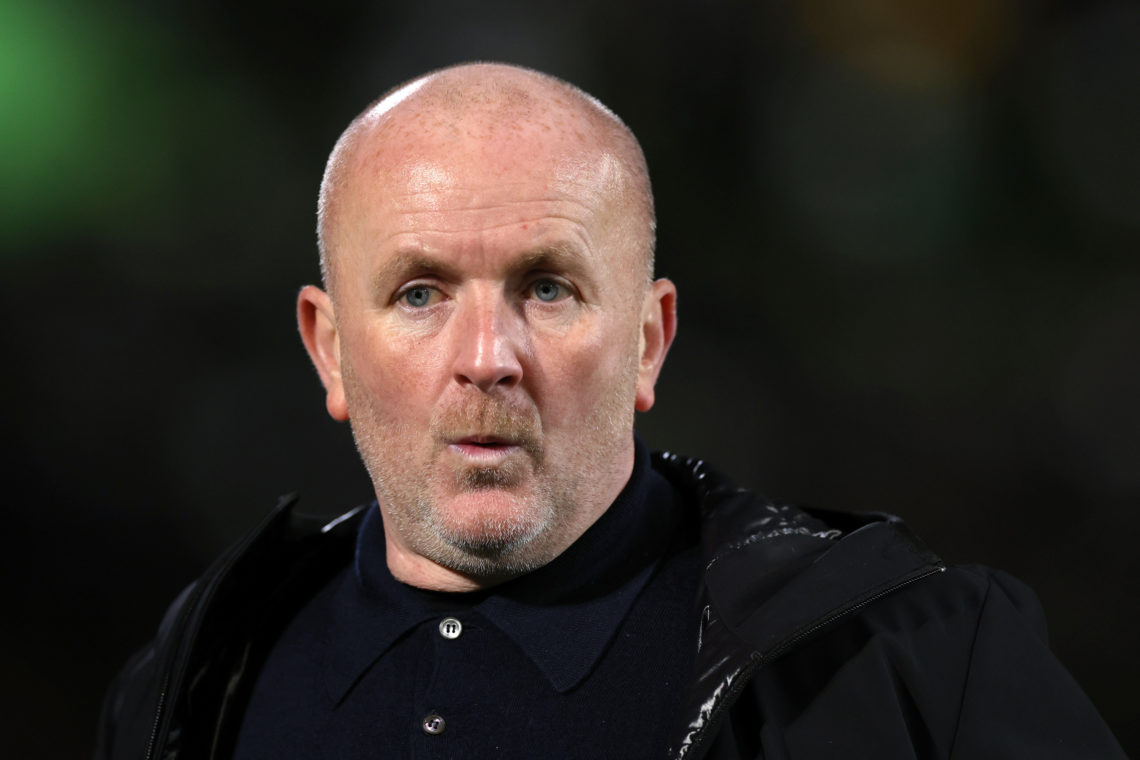


David Martindale has pushed for change in Scottish football, but his own argument exposes a clear flaw that does not hold up under scrutiny.
Martindale has called for a shift in the Scottish Premiership structure, insisting there is broad support among managers for league expansion.
He also took aim at the current format, stating that playing the same teams four times across a season offers no real benefit.
That criticism is absolutely fair, especially with the league repeating the same fixtures and limiting any real variation across a seasoned campaign.
There’s four games to go – rate Celtic’s chances of winning the title out of 🔟

Martindale’s Celtic-linked Premiership argument starts to unravel
The issue comes when his stance on the Glasgow Derby is factored in, with Martindale stating it is the primary driver to bring the revenue in for the commercial deals.
Martindale said, “Who are these people that are actually saying this is not beneficial to Scottish football?
“Every single manager I’ve met over the last three, four years, is quite happy for change.
“The Scottish Premiership has to go to an extended league. It has to be, for me, a minimum of 16 teams.
“We still need the O-d F-rm games, because that’s the primary driver to bring the revenue in for the commercial deals.
“We still need that, but we can do that. I just feel it can be done, and with a 16-team Premiership.
“Playing each other four times a season. There is nobody, nobody can benefit from that.”
That point cuts directly across his earlier criticism, because the repetition he is calling out exists to protect the Celtic vs Rangers fixtures.
The league schedule is shaped around maximising the Glasgow Derby, which is why teams are forced into facing each other multiple times.
He is arguing against four games while defending how he can protect the derby games, and that contradiction does not hold up.
Celtic and Glasgow Derby reality exposes the flaw in 16-team proposal
Martindale also called for a minimum of 16 teams, but increasing the number of clubs does not remove the need to prioritise Glasgow Derby matches.
If those games remain central to revenue, the structure will still bend to accommodate Celtic and Rangers games as often as possible.
That means fixture repetition will not disappear, it will simply be redistributed across a larger league.
He also insisted that nobody can benefit from that when referring to playing four times a season, yet his solution protects the same cycle.
The claim that every single manager is quite happy for change does not resolve that issue.
There is no detail on what version of change is supported, or whether it includes altering the financial model behind the fixtures.
Martindale is right to highlight the flaw in the current Scottish Premiership system, but his proposal does not address the cause.
It keeps the league tied to the same fixture repetition, and that means the argument for change is not backed up.
Receive a digest of our best Celtic content each week direct to your mailbox