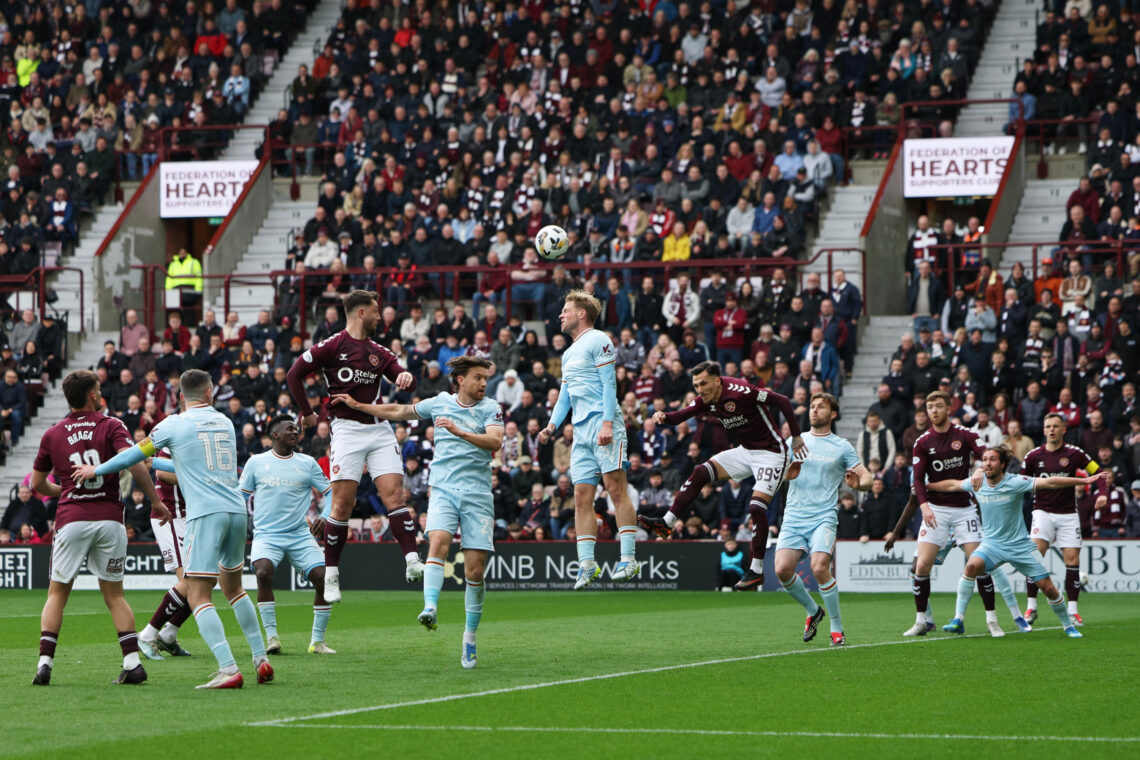


Stephen Welsh’s penalty concession at Tynecastle has sparked a refereeing split, but the key detail at the centre of the decision has been overlooked in the argument against the Celtic loanee.
Welsh, on loan at Motherwell, was penalised late on against Hearts after VAR intervened in an incident inside the box.
The decision came in the 86th minute with the score level, turning what should have been a routine defensive moment into one of the most debated calls of the weekend.
The core of the debate is not the contact itself, but who actually created the danger in the first place, and that is where the pro-penalty argument begins to fall apart.
Will Stephen Welsh ever play for Celtic again?
Explain why in the comments
Celtic defender Stephen Welsh decision hinges on who creates the danger
Welsh’s action was a standard clearance attempt, a defender attacking the ball in a way that is routinely seen across the game.
The opposing player moved into that space to head the ball at a height where a clearance was already being made, and in doing so placed himself in a vulnerable and dangerous position.
That distinction is critical because the laws of the game explicitly recognise situations where a player endangers themselves.
Former SFA referee Des Roache believed the decision to award the penalty was correct, but his fellow podcaster and ex-whistler Steve Conroy had a completely different view.
Conroy told The Ref’s View, “Exact opposite. And it’s good to see sometimes that you can’t legislate for absolutely every eventuality in football. But on this occasion, I’m going against my learned colleague. Stephen Welsh went to blooter the ball clear. No question.
“And sorry, what? Kabore, who was possibly on the receiving end of a foul from Welsh immediately before it was still recovering for that. But there’s no doubt he went to header that ball. So he put himself in harm’s way.
“What’s Stephen Welsh meant to do? Legislate for everything that somebody can do. And that incident is specifically sanctioned by the laws of the game because Kabore is deemed to be reckless or dangerous in that act.
“Because it’s recognised, if you start moving your head about at that level, there’s feet flying about. So I don’t think it’s hard and fast, but it will be interesting to hear Willie Vision [Collum].
“But not in a million years can that be given as a penalty.”
Celtic controversy shows why Roache’s penalty stance does not hold
One refereeing view supports the penalty decision, but it relies heavily on the presence of contact rather than the context of how it occurred.
A contrasting interpretation, grounded in the laws of the game, makes clear that a defender cannot be expected to anticipate every possible movement of an opponent.
When a player lowers their head into a high-foot situation, the risk is clear, and that is a factor officials are required to consider.
Ignoring that element reduces the decision to a simplistic reading of contact, which is not how the laws are designed to be applied.
The Welsh incident is not a marginal call but one where the key detail defines the penalty, and once that is properly applied, the argument for a penalty quickly loses its footing.
Receive a digest of our best Celtic content each week direct to your mailbox