


The SFA have gone as far as consulting IFAB to back their decision on the Hearts penalty involving Celtic loanee Stephen Welsh, but even that level of authority has not been enough to bring the debate to a close.
Willie Collum has presented the Hearts penalty incident as one that is not open to debate, reinforcing the call with confirmation that the game’s law makers are in agreement.
But there is a contradiction that becomes impossible to ignore. Because despite the SFA leaning on IFAB support, former referees continue to reach a different conclusion from the exact same decision.
Has Stephen Welsh proven a point to Celtic with his Motherwell form?
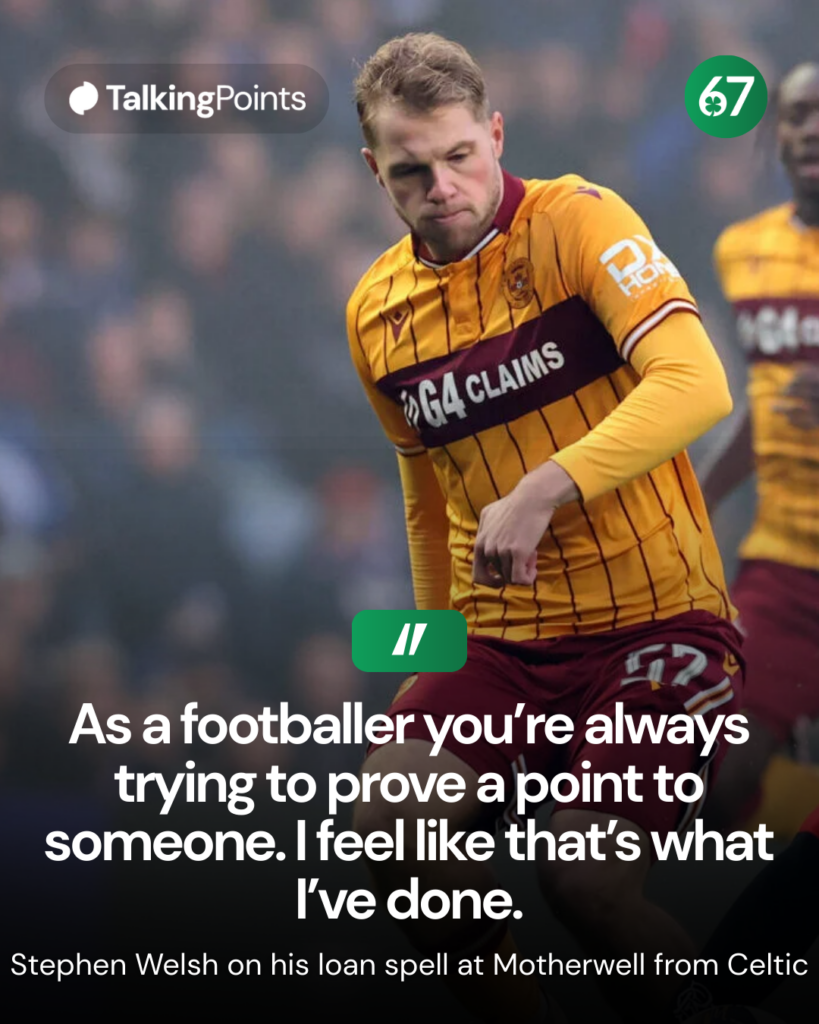
The SFA are ‘clear’ on their Stephen Welsh Hearts penalty stance
Collum’s explanation is designed to remove any doubt and shut down debate. The SFA Head of Referees described the incident as a clear penalty without question and making it clear that this is not just a domestic interpretation.
Collum said, “Yeah, it’s an unusual incident. But it’s a clear penalty kick for us without question. There’s been a lot of discussion about, you know, is this dangerous play from the Hearts player.
“He ends up in the ground naturally and by contact between two players, and I don’t think anybody in football would expect him not to be able to try and make an attempt to play the ball here.
“He’s almost sitting up. I think it’s very different if you’re lying flat in the ground and you’re trying to nudge a ball with your head. That would be ridiculous and that would prevent the player playing the ball, the defender.
“The big issue here is that Stephen Welsh takes a risk. He doesn’t say, ‘I’m not able to play the ball because of the position of this attacker’s head. I’m worried about making contact.’
“He makes the movement. And unfortunately for him, he misses the ball and makes contact with the opponent here.”
“I would pose two questions about this to people as well. You know, if that was a defender in that position, would we say we wouldn’t expect him to head the ball there?
“We would expect them to avoid it for fear of being penalised for dangerous play. And the second thing, how many people in football would be able to accept someone’s kicked in the head and we restart the game with a free kick in favour of the player who kicked him?”
Collum says IFAB agree with Welsh penalty vs Hearts
Collum also pre-empted any backlash from his verdict and consulted IFAB to get their thoughts on the decision. It was an unusual move but the game’s governing body was clear on the Welsh call.
Collum continued, “For us, this is clear. We’ve also spoken to IFAB, my colleagues at IFAB. We had a good discussion with them and everybody’s clear this is a penalty kick.
“Does the level of force come into is there a distinction made because it’s the head? If that contact is on the back of a calf, would you expect a penalty to be given? Are those considerations worth having?
“The referee makes a very good judgment at the monitor because he talks about careless and reckless. They’re both still fouls, but reckless would mean a yellow card there. We don’t think there’s enough force to make that a reckless action, but it’s certainly careless and it’s certainly punishable.”
The message is consistent throughout. Welsh takes a risk, and the SFA are backing that interpretation not just internally, but with the support of IFAB.
The difficulty for the SFA is that the clarity of that explanation does not eliminate the opposing view, it sharpens it.
There remains a key detail within the incident that continues to raise questions about how the situation should be judged when an attacker is in that position.
That uncertainty is not limited to supporter reaction. Former SFA referees have openly criticised the decision, arguing that the circumstances of the attacker’s positioning change the nature of the challenge.
This is where the contradiction becomes unavoidable. A decision described as beyond question is still being questioned by individuals who understand the rules and have applied the same laws being used in its defence.
The SFA can present the ruling as definitive, and it can point to IFAB agreement to reinforce that position. What it cannot do is shut down the debate.
Receive a digest of our best Celtic content each week direct to your mailbox